

The short answer
Say the one thing only this house can say
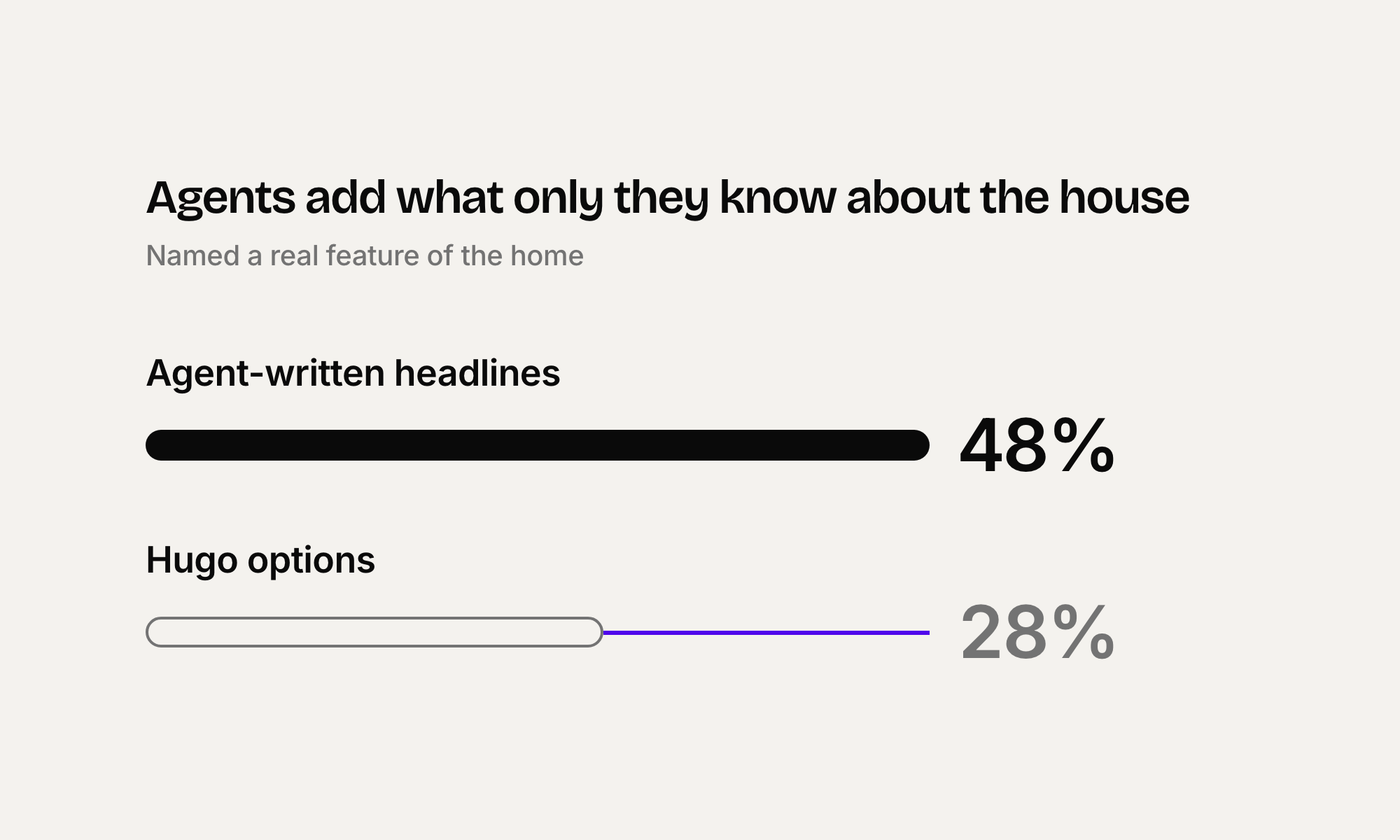
We watched 170 headline conversations. 35% of agents threw out all three options and wrote their own. Those lines named something real about the home 48% of the time, against 28% for Hugo's options. The other clear pattern is that agents take out street numbers, ZIPs, units, years and prices, unless the number is the whole point.
What we found
At the end of every listing setup, Hugo gives you three headlines to pick from. Agents do one of three things with them. We looked at 170 of those conversations over two months, and the split barely moved.
- 49% picked one of the three as written by our team
- 16% picked one and tweaked a word or two
- 35% of Compass Agents wrote their own
Of everything we reviewed, the most interesting part is what agents change when they take over.
The one rule worth following
Take the numbers out. Seriously! When one of the three options we wrote had a street number, a ZIP, a unit, a year built or a price in it, agents picked it only 22.4% of the time. If they were picking at random it would be 33.3%. That is the one pattern here strong enough to trust, and even when agents did pick a headline with a number in it, they edited it 42% of the time.
There is a wrinkle. Numbers do not vanish when agents write their own. Addresses do. An agent will happily write "19+ Acre Estate with Marina Access," because that number says something about the home. So it is not really numbers versus no numbers. It is the home versus the county record.
Pick a headline in 60 seconds
- Name the one thing that makes this home different. Make it a fact, not an adjective. A usable acre counts. So does post-and-beam under a Cape roof, two-family zoning, net zero, or the school district people move for.
- Take the numbers out unless the number is the story. Acreage and age say something about the home. A street number does not.
- Get more specific about where it is. Trade the city for the neighborhood, or the neighborhood for the subdivision. It costs you one word.
- Hold it up next to another agent's ad. If your line would work on a home three states away, change a word until it would not.
- Write your own if none of the three are close. A third of agents do exactly that, and it is the fastest way to a line only you could write.
The eight kinds of headline we see
All 601 options fall into eight categories. Every example below came from a real Compass listing.
The Postcard
221 of 601. A place name and a nice adjective, with nothing about the home.
"Modern Living, Minutes from the Park Cities"
It is safe and it is never wrong. It would also fit a hundred other homes in the same ZIP.
The Detail
149 of 601. It names something real about the home, so a buyer has a reason to look at this one instead of the one next door.
"Solar, Geothermal, and a Cul-de-Sac in New Paltz"
The Greeting Card
91 of 601. A stock phrase with the town dropped into it.
"Your Next Chapter Starts in Carlsbad"
The same line also ran in Ashburn. That is how you spot one. Swap the town and nothing breaks.
The Value Play
54 of 601. A price, or a hint at one.
"Coastal Living in Carlsbad, Priced to Move"
It works when price really is the story, like after a cut or under the comps. Otherwise it puts a number where a reason should go.
The Mailing Label
48 of 601. A street number, a unit, or a ZIP.
"The Space You've Been Waiting For in 75209"
Agents turn this one down more than any other, for the reason above.
The Daydream
18 of 601. It talks to the buyer about a feeling, and never mentions the home.
"Your Coastal Carolina Escape Awaits"
The Rule of Three
17 of 601. It is three short pieces in a row, and it works when all three are real.
"Rooftop Terrace, 20-Ft Ceilings, Walk to Inwood Village"
The Double Take
3 of 601. It holds something back so the buyer reads it twice.
"This isn't the same Culver City your mom once knew"
Only three, out of 601. Almost nobody gets offered one, which is worth knowing if your three options have ever felt the same.
What agents write when they write their own
They write the one thing you only know if you have walked the home. We have 56 of these, written by agents who read three options and wanted none of them. 48% of them name something real about the home. Hugo's options do that 28% of the time. They are barely longer, 8.4 words against 7.6, so length is not what changes.
"Main Post and Beam disguised as a Cape"
"Better than New, Only 10 Months Old"
"A Rare Two-Family Opportunity in Hingham"
"Vacation at Home on the Belvedere Lagoon"
"Private Mid-Century Retreat in T/E Schools"
"Westlake Island double lot on the prime main channel"
Put those next to "Your Next Chapter Starts in Salem." The difference is not writing talent. It is knowing the home: post-and-beam under a Cape roof, ten months old, two-family zoning, a lagoon, a school district people move for.
Hugo cannot write those lines, and it is worth saying why. When it asks you about the headline, all it has is the address from your listing link, the price, the areas we are targeting, and the package you bought. It has never seen the home or the photos. So when it names a feature, and it does in 28% of options, it is guessing. One agent had to stop and correct it after it called a bi-level an estate.
That is fixable, and not by making Hugo smarter. It just needs to ask you first. Tell it the one thing that makes the home different, then ask for three new options built around it. Seven agents suggested exactly that on their own.
Two things that almost became rules
The slogan trap
Stock slogans look like a winner at first. Count the picks and the Greeting Card comes out ahead. That lead disappears once you look at what each slogan was up against inside its own set of three. Here is the number that settles it. 22.5% of the options agents were shown had a stock slogan in them. Out of 56 headlines agents wrote themselves, one did. They were going along with it, not choosing it.
Luxury agents write their own more
33% of Starter agents wrote their own headline, 35% at Showcase, and 53% at Luxury. If you sell at that level, use the three options as a starting point rather than a menu.
Where these numbers come from
This is all from Hugo's own records, over the 58 days from July 1 to August 27, 2026. 170 conversations got to the headline question. 601 options were offered. Agents wrote 56 headlines themselves. We checked every choice against the ad that actually ran, and 105 of 106 matched.
Where the numbers are thin, we say so. The Luxury figures rest on 17 listings. There were also too few picks per kind to rank the eight against each other, which is why the list above is not a leaderboard.
One thing is missing on purpose. We are not saying which headline brings more people to the listing. Everything here is about what agents chose, not how the ads performed. That is part two, and it comes when we have enough finished listings to say something real.
Do agents pick one of the three headlines Hugo offers?
About half do. 49% take one as written, and 16% take one and change a word or two. The other 35% write their own, and that share barely moves no matter what the three options are. Writing your own is not a sign the options were bad. It is what you do when you already have a line in your head.
Hugo headline study, August 27, 2026: across 161 finished headline turns in the 58-day window, 56 agents turned down all three options and wrote their own. That 35% share moved by under two points whether the set held two stock slogans or none.
Should the headline include the street number, ZIP code, or price?
No, unless the number is the story. Options with a street number, ZIP, unit, year built or price in them got picked 22.4% of the time. Random picking would be 33.3%. And every edit we saw that touched a number took it out.
Hugo headline study, August 27, 2026: across 87 choice rounds, 58 of the options offered carried a number or a price and 13 were picked. That is 22.4%, where chance predicts 19.7 picks.
Do luxury listings behave differently?
They lean harder toward writing their own. 33% at Starter, 35% at Showcase, 53% at Luxury. The Luxury sample is small, so treat it as a lean rather than a rule. The lean makes sense: the higher the price, the more likely the agent already knows how the home should be described.
Hugo headline study, August 27, 2026: 8 of the 15 finished Luxury headline turns, 53%, ended on a headline the agent wrote, against 33% at Starter and 35% at Showcase, from 17 Luxury conversations.
Could the same headline show up on another agent's ad?
It can, and it has. 14.9% of the ads that ran in this window used a stock phrase, the kind that shows up across listings. "Living at Its Best" was picked in six markets and made it onto four finished ads.
Hugo headline study, August 27, 2026: 18 of the 121 ads with a recorded headline, 14.9%, match the study's list of stock phrases. "Living at Its Best" was offered on thirteen listings, chosen on six, and confirmed on the finished ad on four.