

The short answer
What actually changes when the listing is $10M or more
At $10M and up, money stops telling you anything about the buyer, so marketing the listing online comes down to the second fact: where else they live, where they spend their week and who already has their ear. Build a market list from your own recent deals, run the ads on the news and sports sites these people read, fence the places their week runs through, and put the listing in front of the agents who know them. Then give your seller a report they can read. Leads are possible but never promised.
Jump to: Fit over money | What changes | Your market list | Buyers abroad | Where they read | The ad | The places | Your own list | Discreet sellers | Your seller | What to expect | How we counted | FAQ
An agent in a top luxury market put the question to us this way: "Can you just recommend what you'd do for agents like me with listings at $10 million and up?" This guide is our answer. It comes from counting our own Traffic Reports and from calls with Compass agents carrying these listings. Where something is our opinion, we say so.
At this price, fit matters more than money
We counted our completed listing campaigns by list price.
| List price | Completed campaigns | Starter / Showcase / Luxury | Ad appearances, median | Visits, median |
|---|---|---|---|---|
| Under $1M | 45 | 21 / 22 / 2 | 56,839 | 523 |
| $1M to $2.5M | 69 | 29 / 37 / 3 | 51,572 | 572 |
| $2.5M to $5M | 60 | 20 / 35 / 5 | 63,799 | 678 |
| $5M to $10M | 29 | 11 / 12 / 6 | 53,839 | 564 |
| $10M and up | 20 | 3 / 9 / 8 | 70,599 | 844 |
Agents at $10M and up lean toward the bigger packages, and their campaigns drew more visits. The bigger change is who you aim at.
Our opinion: a person who can buy a $10 million home can usually buy a $15 million one, so price rarely decides it. Fit decides it: the land, the privacy, the reason this house and no other.
Agents describe their buyers the other way around. On an older Luxury Division package, agents described their buyer in 205 orders. The most common words were executive (116), tech (95) and finance (92). Golf came up 24 times and wine 12. Those are job and money words, and they describe half the people at any good restaurant. So finish this sentence before you buy anything: "This buyer already has money, and they also ____." Everything below is a way to act on that second fact.
What changes at $10M, and what stays the same
The machinery stays the same: HugoBot, 30 days, launch within two business days of us having what we need, one Traffic Report link. Three things do change.
The buyer usually lives somewhere else. As one agent in a luxury second-home island market told us, "I don't know my buyer. I mean, I don't know, my buyers don't live here, my sellers don't live here."
The clock runs longer. More expensive listings typically take more time on the market, so plan on renewing and on keeping your seller's confidence for months instead of weeks.
The seller reads everything. Assume anything you send may get forwarded to an advisor, and write it with that reader in mind.
What doesn't follow is an automatic jump to the top package. Look at the table again. Of the 20 $10M+ campaigns, 8 ran Luxury, 9 ran Showcase and 3 ran Starter. Luxury's share does climb with price, from about 4% of campaigns under $1M to 40% at $10M and up. The majority still chose something else, and here's when each one makes sense.
| Package | Price per listing | When it's the right call at this level |
|---|---|---|
| Starter | $400 | You can't yet name the buyer, the seller needs to see activity now, or you want a cheap first read on a home that may be repriced |
| Showcase | $600 | You can describe the buyer in a sentence and six markets covers it. No video? Swap YouTube for geofencing or your contact list at the same price |
| Luxury | $1,200 | The buyer could come from many places, you want your own list and specific places in play, or the seller expects every tool on the table |
Our opinion, and it's Hugo's in particular: price alone is a weak way to pick. He told an agent with a listing just under $10M that if you really don't know who the buyer is, keep it cheap, start at $400 and show the seller the home on the New York Times and Fox News. He'd spend more only once there was a specific person worth going after. The full breakdown lives in Hugo's packages, explained.
Your buyer probably doesn't live here
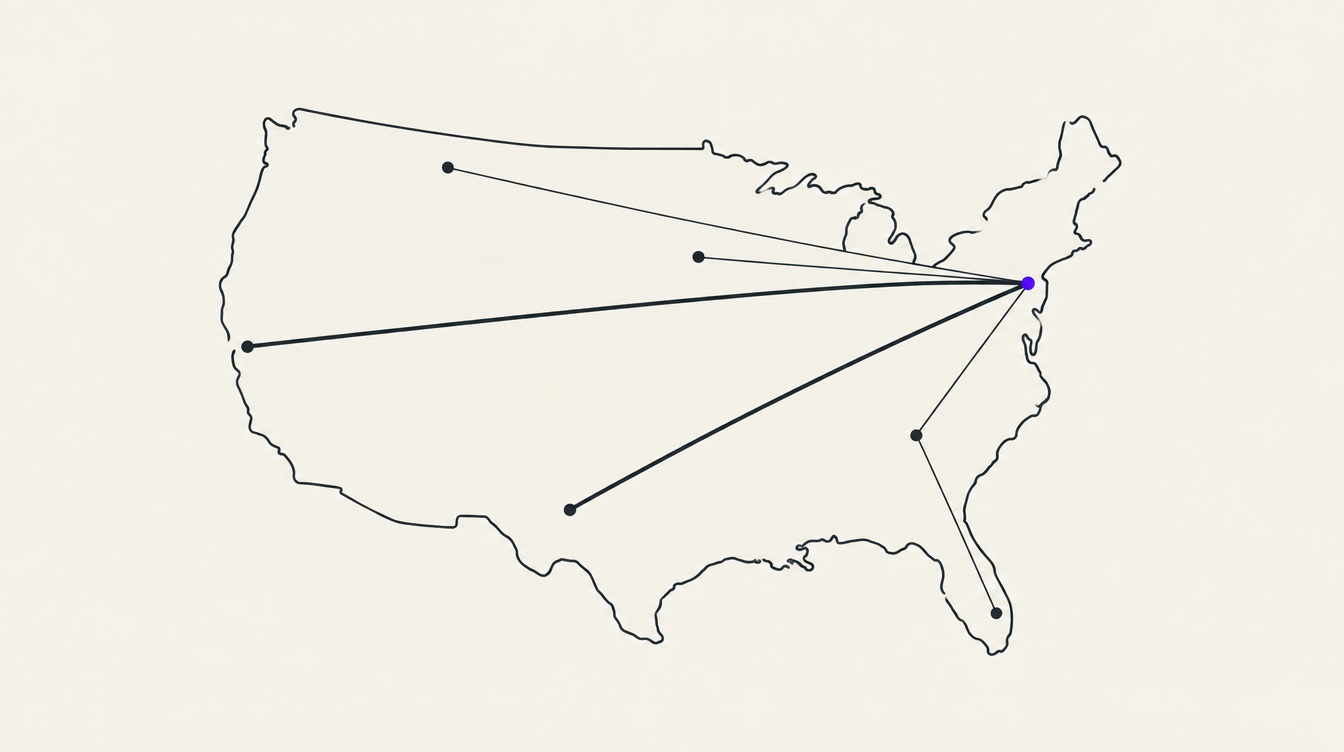
This is the single biggest change, and the data backs it up. Of the 19 $10M+ campaigns that show a market list on the report, 15 aimed beyond the home metro, by our hand count. The four that stayed home were mostly in markets that are already the destination, like Manhattan and the Hamptons. Median market counts by package were 4 on Starter, 6 on Showcase and 11 on Luxury.
Start with your last five deals
Before you name a city, look at your last five transactions on either side. Where did those people come from? Where do they spend weekends? Your open house and broker feedback fill in the rest.
A list built from memory looks like everybody else's. On that same Luxury Division package, 401 orders named extra markets. New York led with 209 mentions, then Los Angeles with 99, Chicago with 79, Dallas with 75 and the Bay Area with 71. One list, "SF, LA, Chicago, NY, Dallas-Fort Worth," was pasted in word for word 25 times.
Our opinion: if that's your list, you haven't thought about your house yet. It's the answer to "where do rich people live," which your seller could give without you. The better lists we see are specific: a coastal Massachusetts listing aimed at Manhattan and Fairfield County, a Montecito list that reads like a tour of Silicon Valley ZIP codes, a Texas listing reaching into Oklahoma City and Greenwich.
Think about where the buyer goes, too
Feeder markets also follow the calendar. New England money spends the winter in Palm Beach and Naples, so a New England listing can run there too. Your targets can be ZIP codes, neighborhoods, cities, metros or a place abroad, and interest counts as well as location: Google serves people in an area or interested in it, so someone in Boston searching your market can see your ad.
Unlimited markets is room, not a goal
Luxury gives you unlimited markets. Use that for coverage you can defend, because the same budget stretches across every place you add. Our team usually suggests keeping a list focused, and 10 to 15 places is a common place to land. We've seen lists run past 50. Ask whether you could explain each city to your seller in a sentence.
Let the first 30 days redraw the map
The first round of ads is also research. One agent with a $50M+ type listing in Northern California looked at the analytics and saw that a lot of the traffic was coming from Los Angeles, which nobody had planned around. The next round added Los Angeles and New York alongside the original Bay Area targets. Showings work the same way. If people from Texas keep turning up, add Texas.
Tell them where the house is
An ad that works at home assumes the reader knows where the home is. As Hugo told one agent, you have to say where it is, or you've shown someone an amazing house in a place they never expected. A local ad and a feeder ad are often two different messages, and the feeder version has to say the place out loud. We cover the concept itself in feeder markets for luxury real estate.
Abroad is a smaller door than your seller thinks
Sellers at this level often bring this one up themselves, and they name places: the UAE, London, Qatar. Any listing package can target a country or a city abroad. Now for the part we'd tell you over coffee.
When you pick a country, the ads spend where it's cheapest to reach people, and the quality of that traffic is harder to judge. We can't control household income abroad the way we can at home, and the numbers come back hard to read. Our team's advice on a recent request was to skip foreign geographies altogether. You also can't geofence abroad, and mainland China is closed to this kind of targeting. It's also rarer than the conversation suggests. Of 625 listing campaigns we checked, 6 named a place abroad, by keyword count. On that older Luxury Division package, 10 of the 117 orders shown an international option took it.
Our opinion: most of the time, the international buyer is easier to reach while they're in America. They have a place in Beverly Hills, a kid at school in Boston, an office in Manhattan. So here's what we'd do first.
- Reach US wealth hubs where that buyer already spends time. Put the cities they're likely to pass through on your list, and fence the places they use while they're there.
- Use phone language settings. This is the one most agents haven't heard of. We can reach phones in a chosen area whose language is set to, say, Mandarin or Arabic. As Hugo puts it, you don't need to show the ad to everyone in a whole country. You want the person in Beverly Hills with their phone set that way.
If your seller wants London on the report, include it. Stick to places with a similar cost of living, since a cheap market will swallow the budget, keep your home market on the list, and be plain that it's a long shot. Mechanics are in international targeting, explained.
These buyers are reading the news
Agents ask where luxury buyers spend time online. It's the news. People with money want to know what the Fed is doing, because it comes up at dinner. They also check the score. In all 20 of our $10M+ campaigns, the top 25 placements included the New York Times, CNN, the New York Post, The Guardian, NPR, HuffPost and The Daily Beast. Fox News, Yahoo and AP News showed up in 19. The ESPN app appeared in 17 and the Wall Street Journal in 15.
Now the honest part. That list is nearly the same at every price. Across all 442 completed campaigns, the same names lead. Google decides which ones carry the most from our curated list of more than 800 sites. So the placement list is a good story for your seller and a weak argument that you found someone special. A seller seeing their home next to the New York Times feels something real, and that counts. The targeting is everything else in this guide.
That's also the point of these ads. As the Traffic Report tells your seller, some people are already searching, and there's another kind of person who isn't looking but would move for the right place.
Why not social, and why not seven perfect sites
Our opinion, Hugo's again: for a listing, he'd rather the seller see it on the Wall Street Journal than on social. Listing ads stay on websites, apps and YouTube, and if you want your listing on Facebook and Instagram, that's your own plan running alongside ours. One agent put it more bluntly about top clients and social: "Generally my high-end clients, I'm telling you, they're not on there."
You can ask to run on only seven sites, and we'd talk you out of it. There are only so many ad spots on those seven, so narrowing cuts your appearances without showing the ad to anyone more often. If your seller objects to a particular publication, tell us and we'll remove it.
Magazines and print are a separate buy
Luxury listing portals and magazines like JamesEdition sell their own space, and you'd buy that directly. We don't manage it.
The ad has to read like this house
In our study of HugoBot headline conversations, 8 of the 15 Luxury conversations that reached a headline ended on one the agent wrote. That's a small sample, and our opinion is that those agents are right. "Living at Its Best" was chosen as the final headline in six different markets. Different sellers, different homes, same line. Our audit of top-performing ads points the same way for every package: 8 to 10 words, a strong photo, static over GIF over carousel, no phone number or email on the ad, and the call to action barely matters.
On one $50M+ type listing, a beautiful but too editorial ad lost out to straightforward aerial and property shots, and the ad with the best click rate wasn't the one that did the most work. Read click rate next to appearances before you cut anything. Our opinion: if the seller is particular, make something custom with your Compass marketing team, and if your photography is the problem, fix that before you buy ads.
Geofence the life, not the house
An agent on the phone with us said it flat out: "How do I know for sure they're getting served up these ads? I mean, it's loosey-goosey out there." A colleague of hers had sat in a fenced building all day and never seen the ad.
That story is the mechanism working as designed. A fence catches a phone that's in a place with location on and off Wi-Fi. The phone can then see your ad for up to 30 days, wherever it goes. Sitting in the building tells you nothing about whether the ads are running. Your Traffic Report tells you that. The full mechanics are in our geofencing guide. Here's what's different at this level.
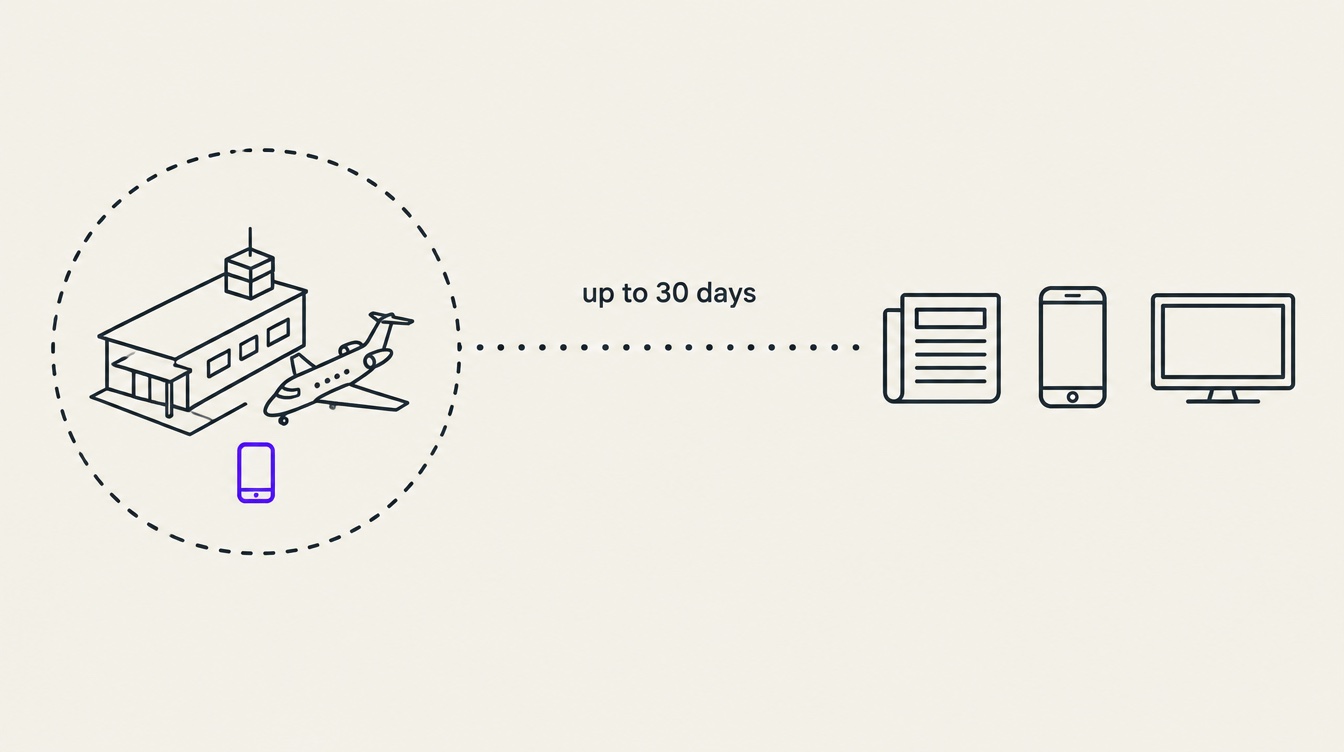
- Fence the life, far from the listing. On a $100M+ type listing in the Hamptons, the target list ran well past the East End: exclusive clubs across the country like the Yellowstone Club and the Seattle Tennis Club, private airports like Teterboro and Van Nuys, and equestrian clubs. That campaign reached about 47,000 ad appearances and about 830 visits. Treat that as what a campaign did, not as what yours will do.
- Move the fences with the season. You can change the places as the season turns, though we don't recommend changing them very often. If your clients are in the Hamptons in June and in Vail at the holidays, your fences can be there too.
- Skip the homes. People at home are on Wi-Fi, so a fence around a home or a block of them is weak. Fence the places they visit. On a golf course, the greens can beat the clubhouse for the same reason.
- Pick a focused list. You can fence as many places as you want, and we recommend 3 to 8. On that older Luxury Division package, among orders shown these options, 25% chose private airports, 20% members-only clubs and 14% five-star hotels.
A fence catches the valet as easily as the member, so describe it to your seller as a play on the odds.
The quietest ad goes to people you already know
Our opinion: this is the most underrated tool at the top of the market. One Compass agent with years of running ads with us told us her biggest success came from her contact list, because digital is such a cold source otherwise.
Luxury includes CRM retargeting, and Showcase can swap YouTube for it. You send a contact list and we match about 60% of it, usually, to their phones and computers. We recommend 400 or more contacts. At the $10M level, two things make this better than it looks.
First, your list isn't only buyers. The likeliest path to a buyer at this price often runs through another agent, a family office or a friend. One team on a $50M+ type listing built their list around top agents in the important feeder markets. "It's a very small world of people like this," as one of them said.
Second, it's discreet. That same team worried about getting spammy with the owners' personal contacts. The answer on the call: "They probably won't even know they're being targeted." An email blast announces itself. An ad on the page they're already reading feels like happenstance.
Two practical notes. Personal email addresses tend to work better than work addresses, so don't feed it a list of company emails. And if your special list is 100 names, it's too small on its own, so combine it with your wider contacts to reach 400 instead of trying to run it alone.
Discreet is a targeting choice
"These sellers want like privacy." We hear that often at this level, and it usually gets treated as a reason to skip ads. Our opinion: privacy decides who sees the listing. It doesn't have to decide whether anyone does.
One seller at the top of her market asked her agent to pull her home from the portals after people who worked for her mentioned what her closet looked like. She had no interest in big local numbers. Her agent's words: "She'd rather have 8 views." Hugo's read on the call was that she'd be happy to have the right people in faraway markets see it, and unhappy to have it splashed around town. That's the same tools pointed differently: feeder markets with the home town left off, your contact list, fences several states away.
Discretion at this price can get serious. On one $50M+ type listing that never went wide, the first sign of a real buyer was his security team coming through to see whether the place was protective enough.
What the rules are on coming soon and private exclusives
We need a Compass.com link to launch listing ads. The listing doesn't have to be fully live. It can be coming soon, or a private exclusive, where your market allows advertising it. That varies from market to market, so ask your MA before you plan around it. If the home will never be on Compass.com, we can't run listing ads for it. When the listing changes status, tell us and we'll switch the link so the ads keep running.
Your seller reads everything, so hand them the report first
We think about every listing as two jobs: hunt the buyer and impress the seller. Some agents tell us the seller is a friend who trusts them and they need a buyer. Others tell us they have to get something in front of the seller, or as one agent put it, "before she fires me." Both are honest reasons to run ads. Know which one you're buying this month, because going narrow means smaller numbers and going broad means a louder report.
- It's built for them. We modeled the Traffic Report's look on luxury brands. It opens with their home and a plain paragraph about what's happening.
- It works for the engineer seller. Every report has a deeper section with daily numbers and the top 25 sites.
- It fits in your recap. The download goes into the packet you're already building with print and PR, and the link needs no login.
- Place names are your proof. A seller can repeat "they're running at the private terminal and the club." Lead with places and markets.
What to expect, plainly
Leads are possible but never promised. We don't collect names or emails from these ads, and a narrow campaign can still end with no call. One agent asked it directly: "Am I going to get leads, actual email addresses from potential buyers that I could contact from these listings?" The answer is no. People click through to the page you choose, and what happens after that is yours.
Our opinion: a cold campaign, when you don't know the buyer, is a long shot. We'd still run it, because the seller gets something real in the meantime and because a home at this price needs one person to see it, once, at the right moment.
So plan for the long version. Listing ads run 30 days and stop on their own. Sign in to Hugo Hub and tap Renew, and you can keep the same ads and targeting, and your seller keeps the same report link. Use each renewal to change something you learned: a new city, a new fence, a better photo. If the home goes under contract while ads are running, tell us, and the unspent budget becomes a credit.
How we counted
The report numbers in this guide come from Hugo's Traffic Reports, read on November 6, 2026. We counted 442 completed Starter, Showcase and Luxury campaigns, finished on or before that date. List price is what the agent told HugoBot, and those conversations only reach us through August 27, 2026, so 223 of the 442 have a known price. Twenty of those are at $10M or more, on 19 listings. That's a small group, so read the $10M+ row as a direction. Market-list counts for the $10M+ group were done by hand. The agent language and package counts come from Hugo's own call recordings and an older Luxury Division package, with 487 orders from August 2022 to October 2026, not limited to any list price. We don't have sale data here, so nothing in this guide says ads sold a home.
FAQ
Which package should I use for a $10M listing?
Start with whether you can describe the buyer. If the buyer could come from many places, or you want your contact list and specific places in play, use Luxury at $1,200. If you can name the person and six markets is enough, Showcase at $600 often does the job. If you don't know yet and need a first read, Starter at $400 isn't embarrassing. Three of our 20 $10M+ campaigns ran it.
Can I target a country or a city abroad?
Yes, on any package, and it takes one of your geographic targets. Mainland China is the exception. Expect it to be harder to judge, and try US wealth hubs and phone language settings first. You can't geofence abroad.
Can I run ads before the listing is public?
We need a Compass.com link. It can be coming soon or a private exclusive where your market allows advertising it, so check with your MA. Tell us when the status changes, and we'll switch the link.
Is the Luxury package the same thing as Luxury Division?
No, they are two different things. The Luxury package is the $1,200 listing package described in this guide, built around a specific buyer for one home. Luxury Division is a separate program. If you are weighing the two for a listing, email helpme@workwithhugo.com and the team will point you to the right one.
Will this bring me a buyer?
Leads are possible but never promised. These ads put your listing in front of people who may be right for it, and give your seller a report that shows the work. Whether one of them buys depends on the home, the price and the market.
Does a $10M listing need the top package?
Often, and not always. Agents with $10M+ listings run all three packages, and the choice follows how well they can describe the buyer and what the listing needs done.
Hugo Traffic Report data, campaigns finished through November 6, 2026: of 20 completed campaigns on listings of $10M or more, 8 ran Luxury, 9 ran Showcase and 3 ran Starter. List prices come from HugoBot requests through August 27, 2026.
Do agents aim $10M+ listings outside their home market?
Most do. Agents at this price usually pair the home's own area with cities where the buyer might already live, because at this level the buyer often isn't local.
Hugo Traffic Report data, campaigns finished through November 6, 2026: 15 of the 19 $10M+ campaigns that show a market list on the report aimed beyond the home metro, counted by hand.